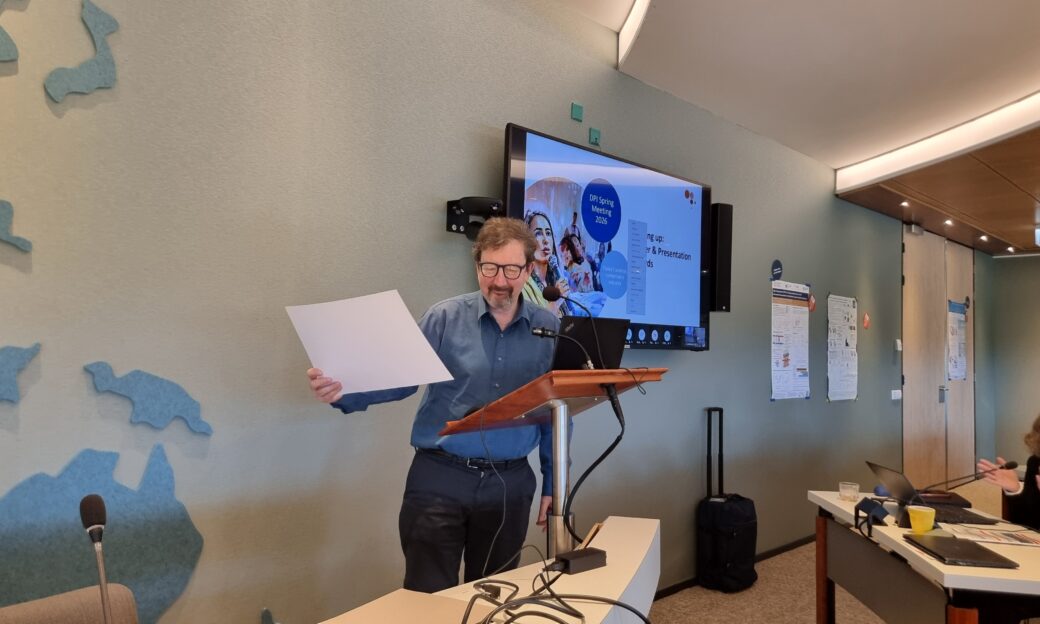
AI is transforming polymer science, but its success doesn’t depend on technology alone; it depends on people. At the DPI Spring Meeting 2026, Prof. Costantino Creton highlighted a critical challenge: AI tools require dual expertise. Material scientists understand the problems, while computer scientists build the tools. Without collaboration, AI’s potential in polymer research remains untapped.
Like many of us, Prof. Creton is intrigued by the possibilities of AI. What does it have to offer, will it actually contribute to polymer science? This curiosity deepened during his tenure as ERC Synergy panel chair (2023, 2025), where he evaluated multidisciplinary AI-material projects at the highest European level. His conclusion? AI can advance polymer science, but only if we address two critical challenges: data quality and collaboration.
The collaboration gap
Prof. Creton has observed a recurring issue: computer scientists often lack material science knowledge, while experimentalists may resist AI out of fear or misunderstanding. The result? Missed opportunities for innovation. As he put it: “The question of collaboration… material and computer scientists have to talk to each other… the best are probably people who already do simulation because they know the experiment.”
His solution? Bridge the gap through two approaches:
- Multidisciplinary teams: Material scientists and computer scientists working side by side.
- Multidisciplinary individuals: Researchers (e.g., molecular dynamics experts) who understand both experiments and simulations.
Collaboration essential for AI to live up to its promise
AI can only live up to its promise if teams combine deep material knowledge with computational expertise. For example:
- Material scientists define the problems and validate results.
- Computer scientists design algorithms tailored to polymer science’s unique challenges.
- Simulation experts (who straddle both worlds) can accelerate progress by speaking both “languages.”
This collaboration isn’t just ideal; it’s essential for developing AI tools that address real-world challenges, from sustainable materials to advanced manufacturing.
DPI fosters interdisciplinary connections
At DPI, we bring together industry and academia in projects that explore the effective use of AI in polymer science. Our pre-competitive research creates the space for material scientists, computer scientists, and engineers to collaborate, ensuring AI solutions are grounded in real needs and capable of driving innovation.
Join the conversation
Is your team ready for the AI revolution in polymer science? Connect with DPI to build the interdisciplinary partnerships needed for breakthroughs.