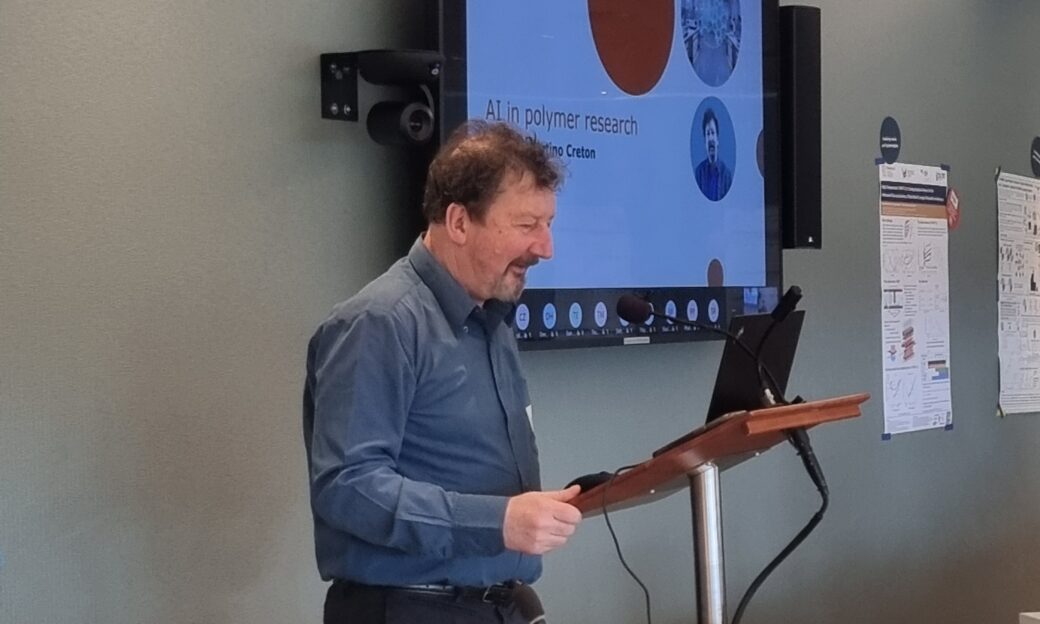
At the DPI Spring Meeting 2026, Prof. Costantino Creton shared a practical approach to accelerating AI-driven innovation in polymer science. His insight? Combine simulation and experiment to generate reliable, diverse data needed to train effective AI models. This hybrid method addresses a critical challenge: experimental data is often limited and costly, while simulations can fill gaps; if validated. Together, they create a powerful foundation for predictive AI, enabling faster and more sustainable material discoveries.
The data challenge in AI for polymers
Developing AI models for polymer research demands high-quality data and that is not always easy to obtain. Experimental data, while accurate, is time-consuming and expensive to produce. Simulations, on the other hand, can generate large datasets quickly and cost-effectively, though they may lack the precision of real-world experiments. Prof. Creton’s solution? Use both.
By training AI models with a mix of simulated and experimental data, researchers can create tools that are both efficient and reliable. This approach allows models to learn from the strengths of each data type, improving their predictive capabilities. For example, simulations can provide broad datasets to identify trends, while experimental data refines those insights with real-world accuracy.
Like many of us, Prof. Creton is intrigued by the possibilities of AI. What does it have to offer, will it actually contribute to polymer science? This curiosity deepened during his tenure as ERC Synergy panel chair (2023, 2025), where he evaluated multidisciplinary AI-material projects at the highest European level. His conclusion? AI can advance polymer science, but only if we address two critical challenges: data quality and collaboration.
Why this matters for industry and academia
This method is not just about faster research; it’s about smarter collaboration. AI models trained on combined datasets can help bridge the gap between fundamental science and industrial application. For companies, this means reducing R&D costs and speeding up innovation. For researchers, it opens doors to exploring new materials and properties that were previously out of reach due to data limitations.
Prof. Creton highlighted that this approach is already being tested in academic projects, where it has shown promise in optimising material design and predicting performance. The next step? Scaling it up for industrial use, where the demand for sustainable, high-performance polymers is growing.
AI in polymer science: a collaborative focus for DPI
Within our Enabling tools & technologies programme, one of the key research areas focuses on AI in polymer science, uniting industry and academia to address shared challenges and shape the future of materials and processes. Want to know more? Get in touch: