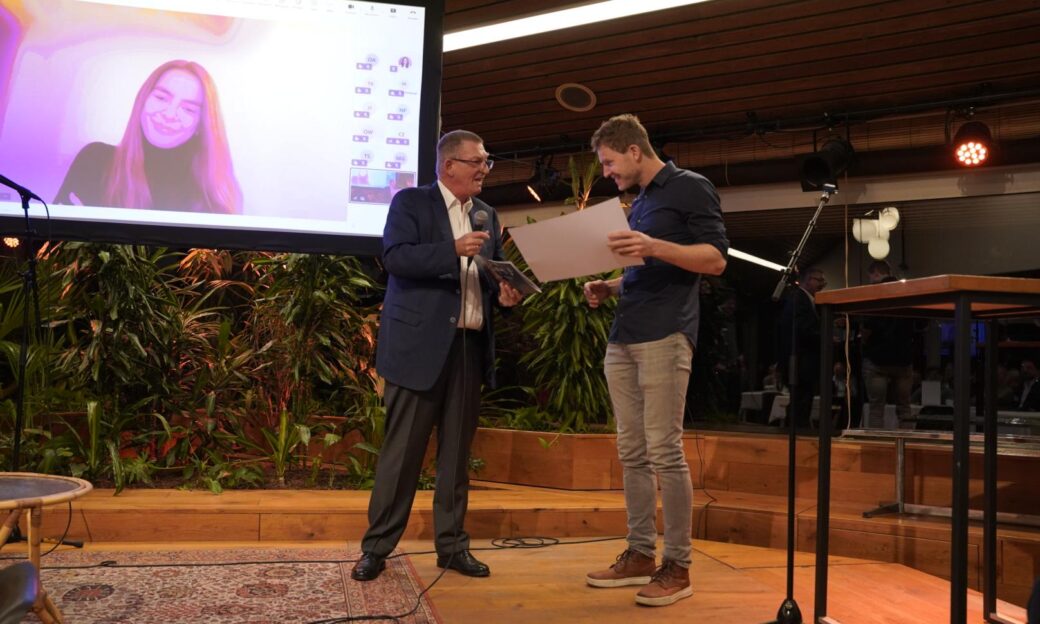
For the first time in the history of the DPI Golden Thesis Award, two researchers have jointly received the award. Dr. Amelie Fuchs and Thijs Egelmeers achieved the same overall score following an assessment combining scientific excellence, industrial relevance and the vote of the audience at the DPI Autumn Meeting in Amsterdam.
Adding new functionality to polyethylene
Dr. Amelie Fuchs received the award for her thesis Organocobalt-Mediated Controlled Free-Radical Co- and Terpolymerization of Carbon Monoxide to In-Chain Functionalized Polyethylenes, based on research conducted within the INRAD project at the University of Konstanz.
Her research explored previously unreported approaches to functionalising polyethylene by incorporating carbon monoxide into the polymer chain using controlled radical polymerisation. The resulting in-chain keto groups offer new ways to tailor the properties of polyethylene, including its photodegradability. By introducing this functionality at the molecular level, the research contributes to a larger ambition: making the world’s most widely produced polymer easier to recycle and reuse.
I am honoured to receive the DPI Golden Thesis Award and equally delighted that the DPI community acknowledges the importance of research addressing the end-of-life fate of polymers. Recognizing this topic is an important step towards a future with more sustainable polymer materials.
Amelie Fuchs, joint winner of the DPI Golden Thesis Award 2026

Understanding fibre orientation during polymer processing
Thijs Egelmeers received the award for his thesis “Fibers suspended in polymer melts: orientation kinetics and rheology”, based on research conducted within the ANGLE project at Eindhoven University of Technology.
His research developed an understanding of the relationship between flow during processing, rheology and fibre orientation in fibre-reinforced composites. Combining experimental and numerical approaches, the work studied fibre orientation kinetics and the corresponding rheology of different polymer melts in extensional and shear flows.
A better ability to predict and control fibre orientation during processing can help manufacturers optimise the mechanical performance of fibre-reinforced polymer components and make processing more predictable.
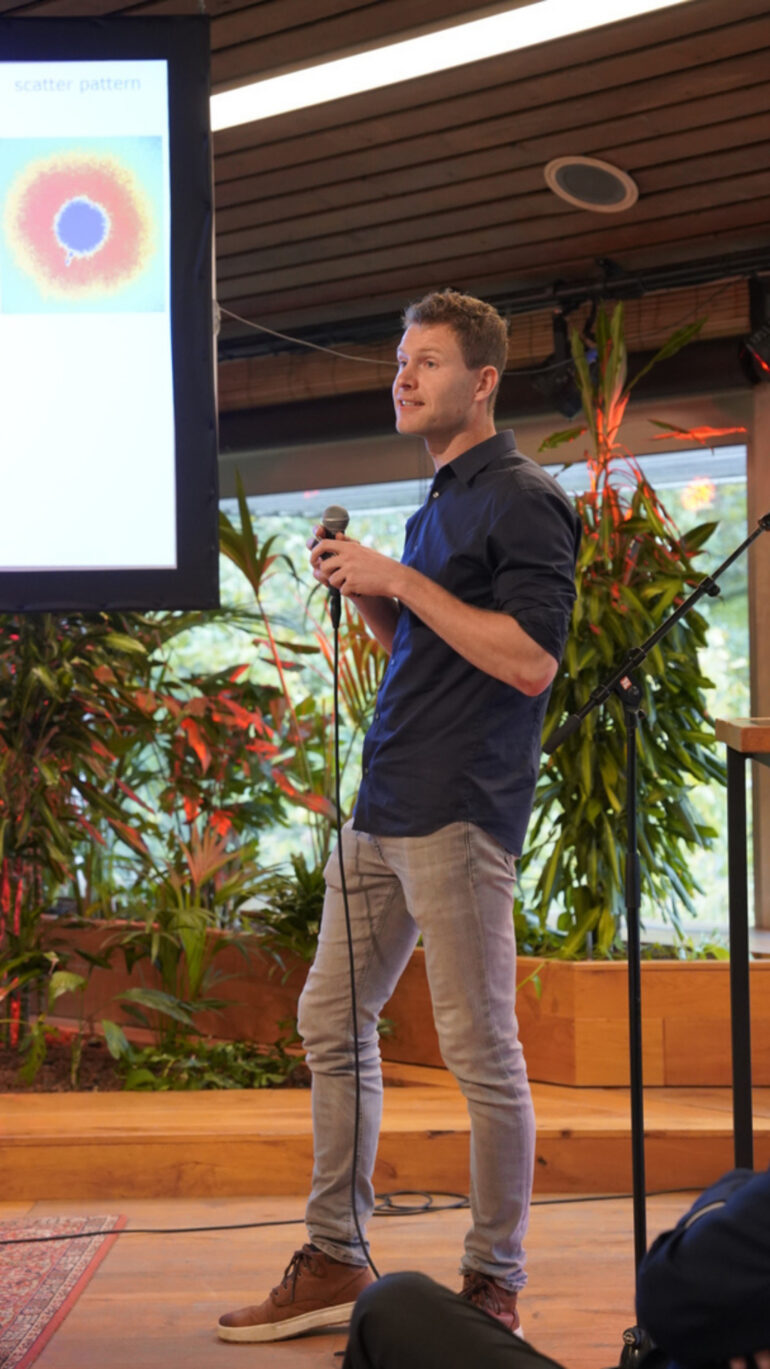
Winning the Golden Thesis Award is an incredible honour! I am proud and grateful to have my hard work recognized, especially by such a broad audience which ranges from professors with deep academic expertise to industrial partners who can apply this research in practise.
Thijs Egelmeers, joint winner DPI Golden Thesis Award 2026
Scientific excellence meets industrial relevance
The four nominees for the DPI Golden Thesis Award were selected by DPI Scientific Advisors Prof. Costantino Creton and Prof. Bernhard Rieger, who assessed eligible doctoral research based on two criteria central to DPI: scientific excellence and industrial relevance.
Following presentations by the four nominees at the DPI Autumn Meeting on 17 November, the audience also cast its votes. The scientific excellence and industrial relevance scores were combined with the audience vote to determine the final result. For the first time, this resulted in an identical overall score for two nominees.
“Selecting just four nominees was no easy task. We saw excellent research across a broad range of polymer science and looked in particular for work that brings new scientific understanding,” says Prof. Costantino Creton, DPI Scientific Advisor.
Prof. Bernhard Rieger, DPI Scientific Advisor, adds: “What also stood out was the connection to challenges relevant to industry. That combination of scientific excellence and industrial relevance is central to DPI, and it is clearly reflected in the work of these four nominees.”
Alongside Fuchs and Egelmeers, Lorenzo Merlonghi of the MuMPoL project at the University of Bologna was nominated for his research into hydrogen transport in semicrystalline polymers. Francesca Gentile of the PERMANENT project at the University of Salerno was nominated for her research into polyethylene-based biaxially oriented mono-materials.
All four nominees presented their work to researchers and industrial partners during the DPI Autumn Meeting in Amsterdam.