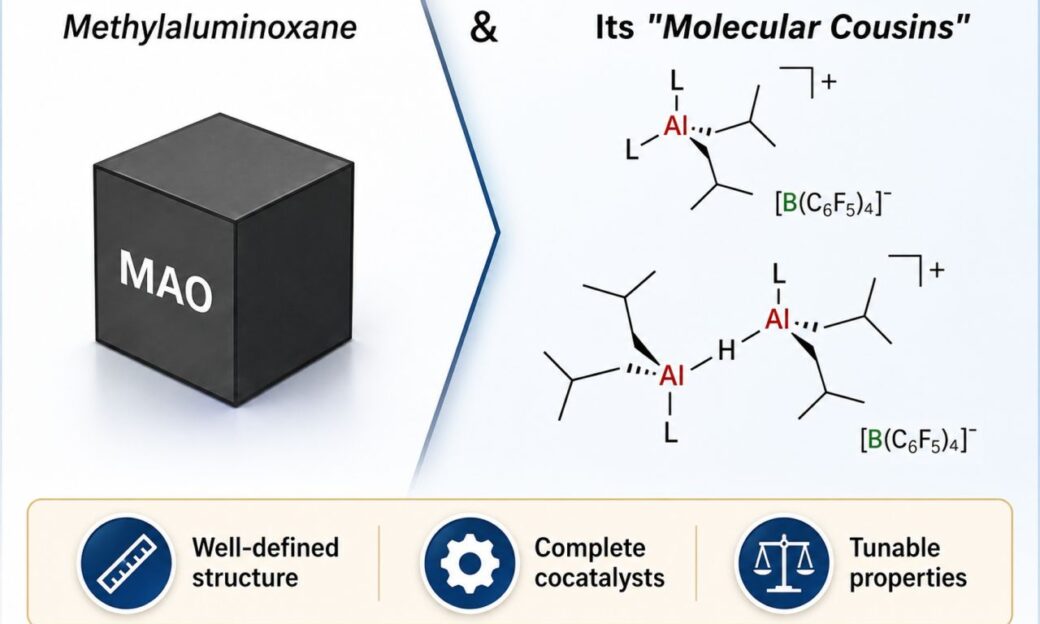
For more than four decades, methylaluminoxane (MAO) has played a central role in polyolefin catalysis. Yet one of the field’s most widely used activators has remained surprisingly difficult to describe at the molecular level.
Connecting expertise around a common challenge
Within the DPI polyolefins community, industrial partners and academic researchers recognised a common need: to move beyond an effective but poorly understood activator towards a well-defined molecular alternative. By bringing together complementary expertise from multiple research groups, DPI helped create the conditions for a long-term, pre-competitive research effort focused on one of the field’s most persistent questions.
The result was a collaboration that combined fundamental organometallic chemistry, catalyst science and polymerisation expertise around a shared industrial challenge.
From a black box to a molecular blueprint
The collaboration led to the development of a new class of well-defined aluminium activators, described as molecular cousins of MAO.
Unlike conventional MAO, these compounds possess a clearly defined molecular structure. This allows researchers to study catalyst activation processes with a level of precision that was previously difficult to achieve. The work demonstrated that it is possible to combine the essential functions of MAO in a single, well-characterised molecular system, opening new opportunities for understanding and optimising catalyst performance.
A contribution recognised by the field
The significance of this work continues to resonate within the international research community.
A recent invited Account in Accounts of Chemical Research revisits the history, development and properties of these “molecular cousins” of MAO, placing their discovery in the broader context of olefin polymerisation catalysis and exploring how the concept has developed since.