
DPI is all about connecting academic and industrial expertise in view of the future of polymers. This is no mean feat, as both sides differ in their premises, habits, and expectations. We talked with university professor Anton Ginzburg and industry research manager Markus Gahleitner about the opportunities and pitfalls of academic research, and how connecting with industry will boost relevance.
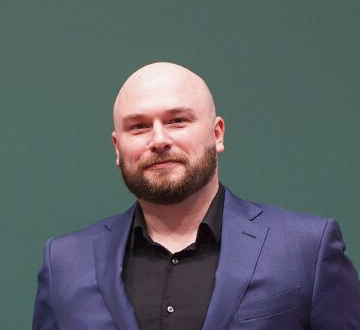
Anton Ginzburg obtained his PhD at TU Darmstadt within a DPI project over a decade ago. Currently an associate professor at KU Leuven, he has also gained experience as an industrial researcher, working eight years at SABIC. “My vision as an academic is definitely a function of the path I’ve been on”, he says. “I want to work on real things. Many academics are totally fine devoting all of their time to fundamental research and not being involved with industry. That’s just not my thing. I’m excited about researching polymer materials that at the end of the day aim at something concrete.”
In his research portfolio, Ginzburg maintains a healthy balance between projects which are typically funded by national or European agencies and projects in collaboration with industries. He says such collaborative projects are definitely more demanding and challenging compared to working on a purely academic project. But he is more than happy to make the effort:
If you can tap into money coming from companies, it means that they believe in you and in your research. What’s more, when I’m in touch with industries, I have a lot more leverage than when just writing a scientific paper. I can influence things, present convincing arguments that are relevant to the industry.
Anton Ginzburg, KU Leuven
The need for funding
From an industry perspective, Markus Gahleitner emphasises the relevance of academics who really make an effort to understand the industry’s perspective. As Senior Group Expert Polypropylene at Borealis, he is involved in projects with various universities – both in a bilateral fashion and in the pre-competitive collaborative DPI setting. Their success hinges on finding researchers with the right mindset, he says, which can be quite a challenge. “Not everybody in academia can relate to the issues of industrial research. On the one hand these are sometimes considered as trivial, on the other hand as far too complex to be dealt with fundamentally. Academics sometimes like to study simplified systems and underestimate the complexity of researching real-life issues. But if you find the right people, it can be very rewarding.”
Both Ginzburg and Gahleitner feel that academia could benefit from a more industry-related perspective. Gahleitner for instance remarks that academia has a tendency to stick to the beaten path: “I’ve seen quite a few project proposals where researchers just tag something to make it look relevant, while they’re just pursuing their own line of research. We have to be critical about that.” Ginzburg in part understands this based on the need of academia to obtaining funding. This has another effect, he notes: “When funding agencies prioritise certain topics, you see many researchers jumping on the bandwagon, but not always in the most relevant fashion.”
It’s about relevance
Gahleitner acknowledges that a key characteristic of good science is to simply believe in the things that you’re doing.

But the other thing in the story is about relevance. I think that in polymer research we have a societal responsibility, both in industry and in academia, to do things that in the end are relevant to society. It should neither be about mere economical optimisation for industries, nor about science for the sake of science.
Markus Gahleitner
Working closely with industry and being willing to tap into the huge existing body of knowledge is crucial to doing relevant polymer science, says Ginzburg. “In a nutshell, research on polymers, has to be applied. Of course, you also need to study fundamental aspects. But without an outlook on application, chances are that a scientific paper is the only result you will have, and that’s where it will end. If you look at the history of polymers, most of the discoveries that made it to real-life application and evolved into multi-billion dollar industries came from researchers that were driven by the applied nature of things.”
Who’s talking
Anton Ginzburg is an associate professor in the Department of Chemical Engineering at KU Leuven (Belgium). He obtained his PhD at TU Darmstadt (Germany) in 2012 on research carried out within a DPI project. Ginzburg then joined DPI industrial partner SABIC as a research scientist, where he was also involved in DPI projects. In 2020 he moved to KU Leuven, where he researches new polymeric materials using accessible building blocks and advanced analytical methods.
Markus Gahleitner is Senior Group Expert Polypropylene at DPI partner company Borealis. He provides scientific support to Borealis’ research and development efforts, manages all aspects of intellectual property, and is responsible for internal training of Borealis researchers. He is also involved in cooperative projects with various universities and represents Borealis in DPI. Gahleitner has authored over a hundred peer-reviewed scientific publications and holds many patents.
This interview is the fourth in a series of five, exploring the added value of pre-competitive research and the role of the DPI community in advancing polymer innovation. The series is produced by science writer Harm Ikink. Other interviews in the series are:
- It’s a huge risk to mistake a symptom for the actual problem, with Markus Gahleitner (Borealis), and Rein Borggreve (DPI)
- If you just deliver on business needs, you might miss out on tomorrow’s trends, with Markus Gahleitner (Borealis), Anton Ginzburg (KU Leuven), and Aurélie Bourdet (Hutchinson)
- This was a fantastic opportunity, I was able to learn so many things, with Markus Gahleitner (Borealis), Anton Ginzburg (KU Leuven), Aurélie Bourdet (Hutchinson), and Rein Borggreve (DPI)
Curious to learn more? Meet our community, get to know our way of working or get in touch: